
Table
Masked Booby/Nazca Booby – Accepted |
|||||
1. 05 Apr 1990 |
H-SY |
~2 nmi. w Pt. Lobos MTY |
1990-052 |
15,26 |
ph., Patten & Erickson (1994) |
2. 30 Jun 1992 |
H-SY |
Newport Beach ORA |
1992-210 |
18,26 |
|
3. 30 Apr 1994 |
H-SY |
~3 nmi. s White Pt. LA |
1994-084 |
20,27 |
ph. |
4. 16 Jul 1996 |
H-SY |
~23 nmi. wsw San Miguel I. SBA |
1996-115 |
23,26 |
|
5. 15 Jun 1997 |
H-SY |
~10 nmi. w Pt. Arena MEN |
1997-130 |
23,27 |
|
6. 13 Feb 1999 |
SY |
~7.9 nmi. sw Wilder Ranch SCZ |
1999-067 |
25 |
Fig. 73, ph., NAB 53:204, Roberson (2002:267) |
7. 22 Jul 2001 |
S-TY |
~10 nmi. off Long Beach, LA |
2001-167 |
27 |
ph. |
Figures
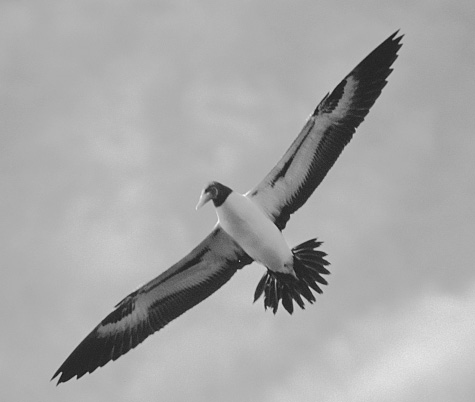
Figure 73. Following recent recognition of the Nazca Booby as a sibling species of the Masked, the potential for distinguishing juveniles in the field has generated considerable debate. The Committee is not yet convinced that positive identification is possible given present knowledge, so birds such as this one—photographed on Monterey Bay, Santa Cruz County, 13 February 1999—have been left in a state of uncertainty (1999-067; John Sorensen).
Nazca Boobies
MASKED BOOBY/NAZCA BOOBY
Sula dactylatra Lesson, 1831/Sula granti Rothschild, 1902
Accepted: 7 (100%) |
Treated in Appendix H: no |
Not accepted: 0 |
CBRC review: all records |
Not submitted/reviewed: 0 |
Color image: none |
Bill color is the only currently proven diagnostic feature distinguishing the Masked and Nazca Boobies in the field. All adult and subadult birds in this complex seen in California have had the yellow bill characteristic of the Masked Booby (see the previous species account). Although some features of juvenal plumage appear to differ (Roberson 1998), at least on average, there is considerable overlap, and the plumage variability of juveniles of known parentage has not been quantified. Without recourse to bill color, definitive plumage characters, or DNA analysis, the Committee has been unable to determine the species of any of six juveniles that have occurred in the state, all since 1990. A seventh subadult, thought to be in its second or third calendar year, showed “pale yellowish in the bill and a broad white cervical collar” (Garrett and Wilson 2003), leading some Committee members to conclude that it was a Masked. Note as well the record of a juvenile Masked/Nazca Booby photographed at the Islas Los Coronados 23 April 1988 (Everett and Teresa 1988).
Nazca Boobies breed mainly on the Galapagos Islands and the Malpelo Islands (off Colombia), but small numbers breed in sympatry with Masked Boobies on Clipperton Atoll and the Islas Revillagigedo (Howell and Pyle 1997, Pitman and Jehl 1998), where limited interbreeding occurs (fide R. L. Pitman). The species has been recorded off western Mexico (Howell and Engel 1993) and in the Gulf of California (Tershy and Breese 1997), and on 27 May 2001 a juvenile (species confirmed by DNA analysis; T. Steeves in litt.) landed on a fishing boat approximately 50 nautical miles west of Punta Banda, northwest Baja California. It was captured on 29 May after riding the ship into San Diego Harbor. On 22 June, after completing rehabilitation, this bird was released on San Diego Bay (see the account on page 450).